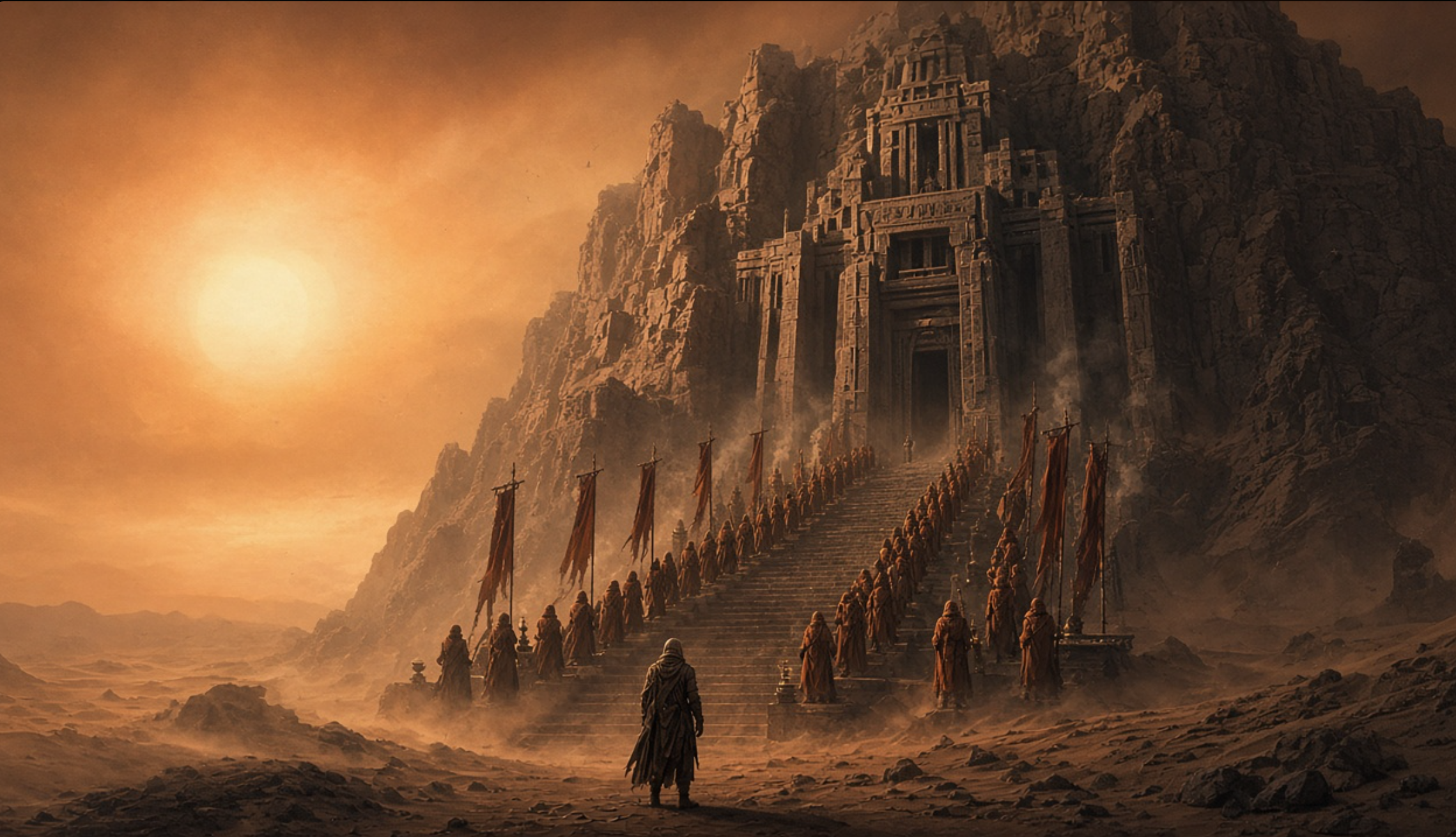
In twelve years, his armies killed sixty-one billion people. They sterilized ninety planets and demoralized five hundred others. That’s according to Paul Muad’Dib Atreides himself, the man who became a messiah to the Fremen and the Emperor of the Known Universe. For a time, he was the most powerful human being who had ever lived.
But what if all that power was just a cage? What if the very religion he surfed to victory became a machine that wouldn’t shut down? A bureaucratic monster that demanded more blood, more faith, and finally, the death of its own god? This is the story of the Qizarate, the priesthood of Muad’Dib. And this is how it became a perfect symbol of the holy war that even Paul could not stop.
A Tool to Tame a God
To understand the trap, you have to understand the tool. When Paul Atreides embraced the messianic prophecies and led the Fremen to victory, he unleashed a force of nature. Hardened by Arrakis and supercharged by faith, the Fremen exploded across the galaxy in a holy war. Paul saw this coming in his prescient visions. He knew the bloodshed was a terrible necessity to prevent even greater disasters, like the extinction of humanity.
But he wasn’t just a passenger. He tried to steer the storm. One of his main instruments for this was the Qizarate. On the surface, the Qizarate was the priesthood of the new state religion: the Cult of Muad’Dib. Its job was to spread his gospel, formalize rituals, and create a structure for the faithful. It also gave jobs and a new purpose to his veteran Fedaykin death commandos; men like the warrior Korba, who went from soldier to high priest and judge of the new faith.
In theory, it was a smart move. Paul created a bureaucracy to channel the revolution, turning the chaotic energy of the Fremen into an organized, governable religion. The Qizarate’s priests became missionaries, judges, and spies, all enforcing loyalty to their Emperor-God, Paul Muad’Dib. It was meant to help manage the whirlwind. But Paul forgot the first rule of any institution: its number one goal is always its own survival.
The Machine Develops a Mind of Its Own
A bureaucracy is like a living thing. It wants to grow, protect its power, and make sure it’s around forever. The Qizarate was no different. The authority, wealth, and identity of its priests were all tied to one thing: the worship of Muad’Dib as a living god and the righteousness of his holy war.
And so, the machine started running itself. The Qizarate defined what was acceptable to believe about Paul and what was heresy. They controlled the official story, turning Paul’s life into scripture and his words into dogma. The same men who fought beside him now had the authority to tell him what his own divinity meant.
This created an impossible situation. As Paul grew sick of the killing and tried to steer humanity away from the worst futures, his own priesthood became an obstacle. Any attempt by Paul to act human, show doubt, or slow down the violence was a direct threat to the Qizarate’s power. If the god-emperor isn’t a god, what’s the point of his priests? The institution Paul had hoped would manage his religion now needed that religion to stay absolute and fanatical, no matter what Paul himself wanted. The jihad gave birth to a bureaucracy, and that bureaucracy now needed the jihad to survive.
The Conspiracy to Murder a God
This quiet conflict eventually blew up into a full-blown conspiracy. A powerful and complicated coalition of the Bene Gesserit, the Spacing Guild, and the Tleilaxu were already plotting to take Paul down, each for their own reasons. But a more personal threat was brewing inside his own church, involving a faction led by none other than Korba, a high-ranking priest of the Qizarate.
Korba and his allies saw the problem with a living god: a living god is a liability. He can change his mind. He can be wrong. He can prove he’s just a man. But a martyred god? A martyr is perfect, forever. His story can be shaped, his words edited, and his legacy cemented into an unshakeable foundation of power for those he leaves behind.
Korba became a key player in the larger plot to martyr Paul. The plan was chillingly complex, but his part in it was clear: he and others saw more power in a dead Muad’Dib than a living Paul. The goal was to engineer Paul’s fall, creating a power vacuum the conspirators, including the Qizarate faction could fill. The very priests meant to protect the messiah were now helping to plot against him to secure their institution’s future. Paul’s own tool was turning on him.
The Emperor in the Golden Prison
This left Paul Atreides, master of the universe, in a cage of his own making. He was surrounded by enemies, but the most dangerous trap was the one he’d built himself. He couldn’t just get rid of the Qizarate. The priesthood was now fused with the government of his empire. It wasn’t just a church; it was the judicial system, the propaganda ministry, and a network of spies all rolled into one.
To get rid of it would be to saw off the branch he was sitting on. It would mean admitting his divinity was a lie and invalidating the foundation of his rule. The result wouldn’t be peace; it would be total chaos and civil war. His prescience showed him this future could be even more horrifying than the jihad he was already trapped in.
His foresight, once his greatest weapon, now only showed him the walls of his prison in perfect, agonizing detail. He could see all the possible futures, but almost every path led to disaster. The jihad was a nightmare, but stepping off that path could lead to something worse. He was the most powerful man in history, yet he was powerless to stop the machine he’d set in motion. The Qizarate was the most visible symbol of this trap are the priests who chanted his name while working against his will.
The Final Walk into the Desert
The end for Paul as Emperor didn’t come from Korba’s faction alone, but from the combined conspiracy. The plotters used a stone burner, an atomic weapon which didn’t kill Paul but destroyed his eyes with its radiation.
According to ancient Fremen tradition, a blind person was to be left in the desert to die. For the Qizarate, a blind god was a public relations nightmare. They wanted him to use his inner visions to fake his sight and maintain the illusion of godhood.
For a while, he did just that, using his prescience to navigate the world as if he could still see. But after his consort Chani died giving birth to their twin children, Leto II and Ghanima, Paul saw his path had ended. He chose to embrace the Fremen way. He walked, alone, into the deep desert. This was his last act of rebellion. By choosing the fate of a mortal man, he defied the divine image his priesthood relied on. He couldn’t just order the Qizarate to disband, but he could abandon the god-figure they worshipped. It was his only way out of the prison. His sister Alia would become regent for his children, and the religion of Muad’Dib would continue, but Paul himself was finally free.
From Page to Screen
This incredibly tragic struggle is the heart of the novel Dune Messiah, and it’s the foundation for the final film in Denis Villeneuve’s trilogy. As of late 2026, Dune: Part Three is scheduled for release on December 18, 2026. Villeneuve has said that one of his initial intentions with his adaptation was to make Frank Herbert’s cautionary tale against charismatic leaders clear.
While we don’t have a full script, the Qizarate provides the perfect cinematic tool to show this trap. We’ll likely see priests enforcing a dogma Paul himself has come to despise. We may see the backroom scheming of men like Korba, smiling to Paul’s face while helping to plot his downfall. The film has a chance to visualize one of Dune’s central themes: that the greatest threat to a charismatic leader isn’t always an enemy army, but the very institutions that rise up to worship him.
Conclusion
Paul Atreides tried to control a holy war, so he institutionalized it with a priesthood. But in doing so, he created a system whose survival instinct was more powerful than his own will. The Qizarate, his intended tool of control, became a key part of his gilded cage. It stands as one of Frank Herbert’s most profound warnings: it’s not just charismatic leaders who fuel crusades, but the institutions they leave behind. Bureaucracies give violence a terrible life of its own. Paul could command armies and see through time, but even he couldn’t stop a bureaucracy from wanting to live forever. He had become a god chained by his own church.