You know, the scariest thing in the original Silent Hill 2 isn’t Pyramid Head. It’s not the twitching nurses or even that oppressive, world-swallowing fog. For me, the scariest thing is a subtle idea woven into the game’s fabric that seems to punish you for the one thing you need to do to survive: look. When the remake was announced for an October 2024 release, I was excited like everyone else. A chance to see this legendary world with modern clarity felt like the ultimate version. But going back to the original, I realized that its strange, almost punishing design is what made it so personal and terrifying. The old game’s awkwardness and restraint aren’t just technical quirks to be fixed; they are the very engine of its horror. It weaponizes your own curiosity against you, and today, we’re going to break down how.
The Beauty of Imperfection
If you looked at it on paper today, the original Silent Hill 2 should be a mess. The combat is a clumsy, desperate affair. James Sunderland doesn’t handle a weapon like a hero; he swings a wooden plank with a heavy, awkward wind-up, and every hit feels uncertain. This is a common point of debate, with some arguing it’s just bad design. But many feel that clumsiness is the whole point. The game isn’t trying to empower you; it’s reinforcing your vulnerability. You aren’t a soldier, you’re a grieving, confused man, and fighting is a frantic, ugly last resort.
This philosophy extends to the world itself. The fixed camera angles of the original were a brilliant solution to the PlayStation 2’s hardware limitations, which Team Silent elevated into an art form. You’re often denied a clear view. You’ll hear a sound off-screen or a shuffle, a moan, the crackle of your radio, and the camera will stay put, forcing you to walk into the unknown. The fog wasn’t just there to hide the limited draw distance, either; it was an active antagonist. It suffocates the world, dramatically reducing your vision and forcing you to rely on your ears.
And this is where the “punishment” begins. The game understands that the deepest fear comes from a question you feel you have to answer. What was that noise? What’s in the fog? While there are plenty of scripted encounters and required fights, much of the game’s tension comes from what it doesn’t force. It baits your curiosity. It makes you an active participant in your own torment. You have to choose to walk towards the static. You have to choose to investigate the sound. The horror isn’t just what you find, but the slow realization that the game is turning your own need to see into a trap.
Guilt Made Visible
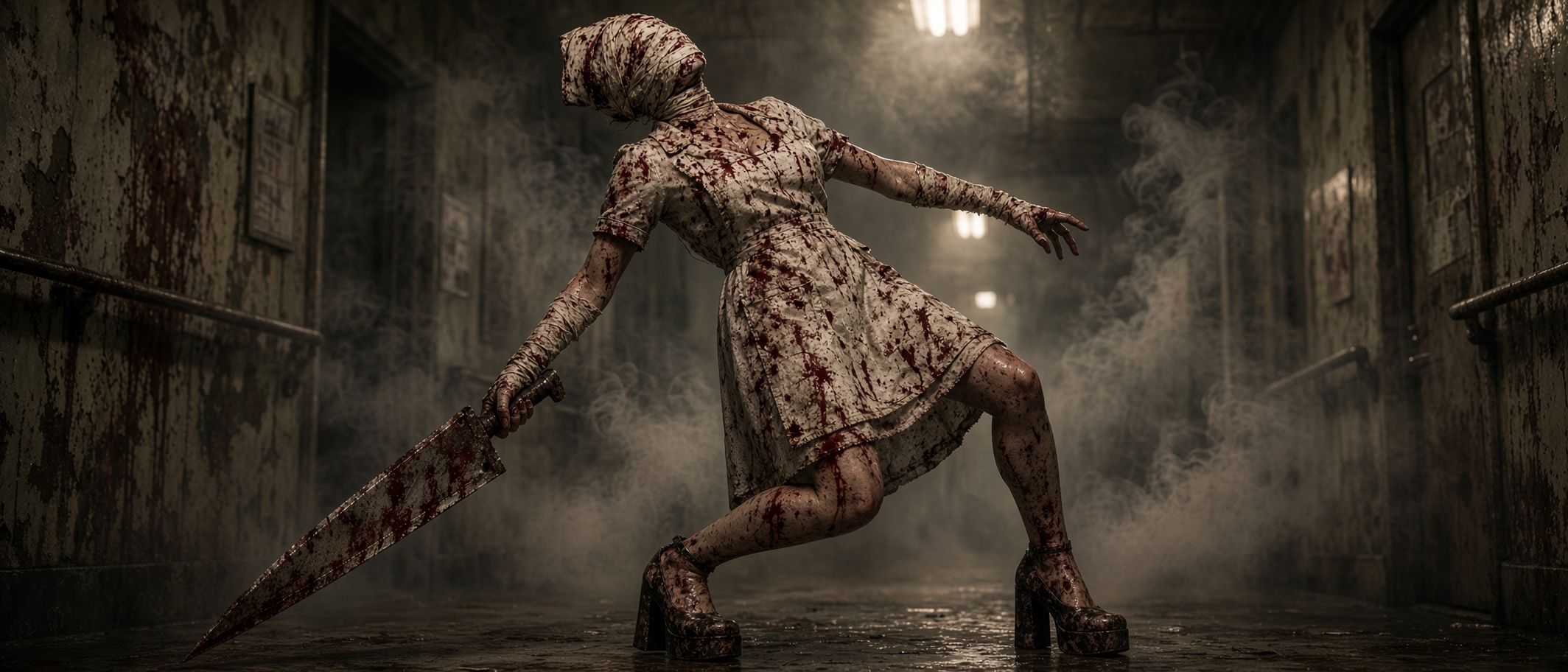
Nowhere is this clearer than with the iconic Bubble Head Nurses. To just call them monsters is to miss the point. In the official Lost Memories guide, they are described as “suggestive of Mary’s hospitalization.” It’s widely interpreted that these creatures aren’t just random ghouls; they’re specters born from James’s fractured psyche.
Their design tells a story. The hyper-sexualized uniforms are often seen as representing James’s sexual frustration and guilt while his wife Mary was terminally ill. Their heads are swollen and featureless, which the monster’s designer, Masahiro Ito, has explained is meant to represent Mary’s head swollen from suffocation. They move with spastic, unnatural convulsions like a horrifying mime of suffering. They are aggression, desire, sickness, and guilt, all wrapped in one twitching form.
So when James fights a nurse, the act feels less like vanquishing evil and more like he’s physically lashing out at his own repressed feelings. This is why those encounters can feel so deeply uncomfortable. You aren’t cleansing the world; you’re taking part in a violent act of self-loathing. Each swing of the pipe feels less like a step towards victory and more like a deeper plunge into one man’s personal hell. The game forces you to look at this ugly, walking symbol of grief and then gives you a weapon, punishing you by making you an accomplice in confronting this raw, psychological wound.
The Problem with Clarity
This brings us to the remake, which launched on PlayStation 5 and PC on October 8, 2024. On paper, it’s a definitive upgrade: rebuilt visuals, an over-the-shoulder camera, and modernized combat. Yet, for some players and critics, something was lost in the translation. A frequent critique is that by making everything clearer and more polished, the remake unintentionally dismantles some of the original’s horror machinery.
The original’s stiff animations and unsettlingly vacant character models were partly due to technology, but they also created a dreamlike, uncanny mood. The characters moved with a puppet-like quality that made the whole world feel “off.” Some critics felt that the remake’s push for realism, while visually impressive, could ground the experience too much, losing that nightmarish quality.
The combat overhaul is probably the biggest point of contention. Giving James a modern combat system with dodging and precise aiming makes him more capable. But in doing so, some reviews argued it shifts the balance away from pure survival horror and closer to an action game. Encounters could become less about a panicked struggle and more of a manageable, skill-based challenge. However, opinions are split; other critics found the new combat still felt weighty and tense, preserving a sense of desperation. The point isn’t that the remake is a bad game, many reviews praised it for its faithfulness and atmosphere, but that its modern sensibilities can sand down the rough edges that made the original so uniquely terrifying for some. The original made you do the psychological work, and true horror often grows in those uncomfortable, ambiguous spaces.
The Unblinking Eye
If you stack Silent Hill 2 up against many modern horror trends, you see just how different its approach is. A lot of contemporary horror masterfully controls your gaze with quick cuts and carefully framed shots that keep the monster just off-screen. The director is in complete control of what you see and when. You’re scared, but you’re a passenger.
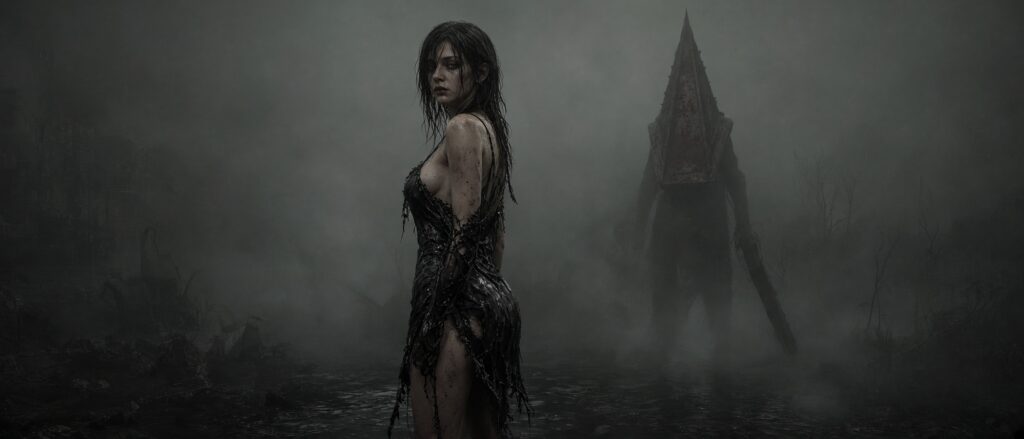
Silent Hill 2 does the opposite. Instead of cutting away, it holds the shot. It gives you a long, fog-shrouded hallway and the distant sound of scraping metal, and then… it waits. It waits for you. The horror here isn’t a jump scare; it’s the agonizing, player-driven choice to walk toward the source of your fear. You’re not a passive observer; you are the one pushing the stick forward, moving closer to the thing your radio is screaming about.
This is the ultimate punishment. The game doesn’t just show you a monster; it makes you survive the agonizing journey to find it, then forces you into a clumsy, desperate struggle. It turns dread into an interactive mechanic. The friction of the controls, the limited sight, the symbolic weight of the enemies as it all serves one purpose: to make the very act of looking and understanding an ordeal.
The terror of the original Silent Hill 2 isn’t in what it shows you, but in what it makes you show yourself. It builds a world from the protagonist’s psychological fragments and then makes the player feel punished for trying to piece them together. The more you look, the more you seek to understand the town, the more it reflects the ugliest parts of its characters back at you. You come to realize its clumsy systems and suffocating atmosphere weren’t flaws to be fixed; they were the pillars of its cruel and personal brand of horror.
While the remake masterfully rebuilds this iconic town for a new era, its existence is also a powerful reminder of what made the original a masterpiece. It reminds us that sometimes, the most terrifying thing isn’t a monster in perfect detail, but a low-resolution, indistinct shape shuffling toward you in the fog, a shape that you, and you alone, have to choose to confront.