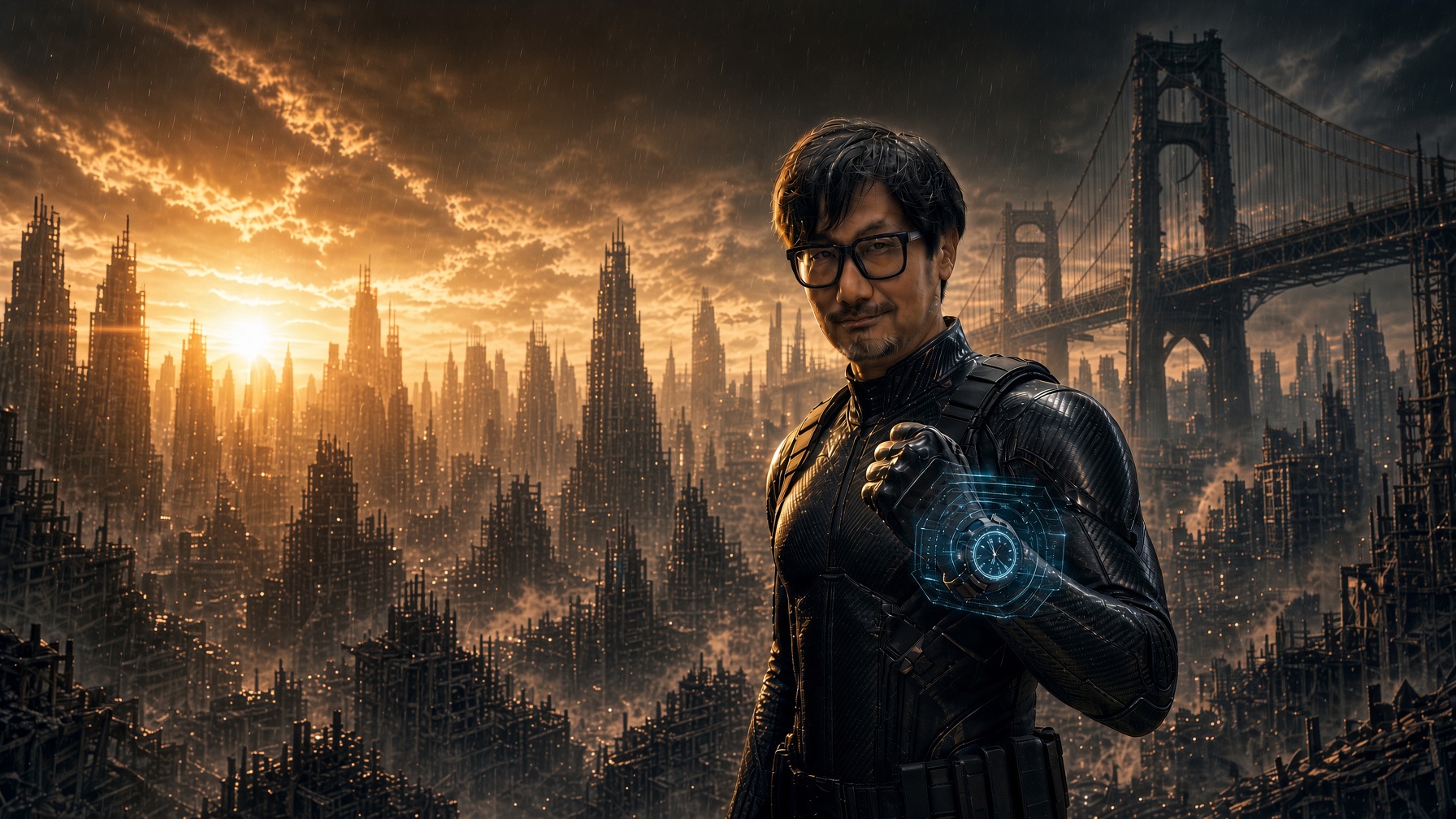
What makes a video game studio more than just a company? For Hideo Kojima, the answer is simple: it’s an extension of himself. Kojima Productions isn’t just a name on a building; it’s the result of a lifelong mission to challenge what a video game can be. The iconic phrase, “A Hideo Kojima Game,” is more than a credit; it’s a bold statement that games have authors, and that this author is willing to take huge risks to create something no one has ever seen before. This is the story of how one man’s name, his vision, and his stubborn drive for creative freedom became an entire studio.
The Auteur in the Machine
To really get Kojima Productions, you first have to understand the man whose name is on the door. Hideo Kojima never actually set out to be a game designer; he wanted to be a filmmaker. Growing up, his parents made movies a daily ritual, and he learned to see the world through a cinematic lens. When he finally joined the games industry in 1986 with Konami, he didn’t leave those ambitions behind; he smashed them right into the interactive world. He’s famously said that 70% of his body is made of movies, and for nearly four decades, he has worked to give video games the language of cinema and its framing, its tension, and its soul.
His signature style was established long before his own studio existed. It was with 1998’s Metal Gear Solid that Kojima became a superstar, popularizing the use of in-engine cutscenes and extensive voice acting to tell a complex story. This approach would inspire countless games. Then, in 2005, in recognition of his team’s success, Konami formalized his unit into a dedicated subsidiary: Kojima Productions. While still under Konami’s roof, this studio became the official home for Kojima’s vision as he and his team continued to refine the ideas that made them legends.
But Kojima’s style went way beyond just making games look like movies. He was obsessed with using the unique language of video games to mess with the player directly. He didn’t just want you to play the game; he wanted you to feel his hand on your shoulder. The most legendary example is the Psycho Mantis boss fight in the original Metal Gear Solid. The villain doesn’t just read your character’s mind; he reads your mind. He comments on the other Konami games on your memory card. He tells you to put your controller on the floor and makes it vibrate with the rumble function. In that moment, the game shatters the fourth wall, reaching through the screen to let you know it sees you. This was Kojima’s signature, evident years before his studio was officially named: using the hardware itself as a storytelling tool and a sign of a creator who refused to play by the rules.
The Great Severance
For nearly thirty years, Kojima and Konami had a complicated but mostly successful relationship. Kojima was even appointed Vice President of Konami Digital Entertainment. He was their star, delivering hit after hit. But under the surface, a classic conflict was brewing: creative freedom versus corporate control. Kojima’s games were getting bigger, more expensive, and weirder. His perfectionism was legendary, but to a company that was starting to focus on safer bets like mobile games, that kind of ambition began to look like a problem.
The breaking point came in 2015, during the home stretch of Metal Gear Solid V: The Phantom Pain. The simmering tensions boiled over and exploded into public view. Then came the ultimate insult: Konami began scrubbing its most famous creator’s name from his own work. The iconic “A Hideo Kojima Game” tagline and the Kojima Productions logo vanished from box art, websites, and marketing materials. To the rest of the world, it looked like Konami was trying to turn one of gaming’s most celebrated auteurs into a ghost.
The fallout was fast and ugly. Konami canceled Silent Hills, a hugely anticipated horror project Kojima was set to co-direct with filmmaker Guillermo del Toro. Its playable teaser, P.T., had become a viral sensation and is now a cult legend, a phantom of a game that hinted at their brilliant collaboration. The message from Konami seemed blunt: the era of the big-budget, creator-driven game was over.
This corporate drama reached its climax on a global stage. In December 2015, Metal Gear Solid V won an award at The Game Awards. But Kojima wasn’t there. The show’s host, Geoff Keighley, walked on stage and told a shocked audience that Kojima was at home, watching, because Konami’s lawyers had barred him from attending. The crowd erupted in boos. It was an unprecedented, jaw-dropping moment that exposed just how bitter the split had become. The creator had been exiled from his own celebration. For many, it felt like the end of an era.
From Zero
Just days after being publicly shut out of The Game Awards, Hideo Kojima announced his comeback. On December 16, 2015, he revealed he had established a new, truly independent studio. Its name? Kojima Productions. This wasn’t just a new logo; it was a declaration that the vision would live on, now completely free from corporate control.
The new studio started from practically nothing. In interviews, Kojima described the early days as beginning “from zero,” with no office, no gear, and just a few loyal staff who walked out with him, including his longtime artistic partner, Yoji Shinkawa. This origin story was key to the studio’s new identity. It was a tale of reinvention, of a legendary creator starting over with little more than his reputation and an unstoppable urge to create.
But he wasn’t completely on his own. In a huge show of support, Sony Interactive Entertainment announced it was partnering with the new studio to fund and publish its first game. This was a massive vote of confidence, not in a proven company or a big franchise, but in one person. Sony was betting on the auteur. They knew Kojima’s name itself was a brand with a fiercely loyal global fanbase. This partnership was a major moment, validating the idea of the “celebrity creator” in gaming.
The new Kojima Productions was built from the ground up to embody Kojima’s philosophy. Its logo, featuring a figure named Ludens, symbolizes “the one who plays,” a nod to their mission of finding new ways to play. The Tokyo studio itself was designed as a creative hub where Kojima could direct everything, from grand ideas down to the tiniest details. He was finally free to build not just a game, but an entire universe. The man whose name had been stripped from his own work now had a studio where his name was the very foundation.
A Declaration of Independence
With his independence secured and Sony’s backing, the world watched. What would Hideo Kojima create now that he was totally untethered? The answer was Death Stranding. Released in 2019, the game was anything but a safe bet. It was a blockbuster title about a deliveryman crossing a fractured, post-apocalyptic America. Its core gameplay wasn’t about fighting, but about walking, balancing, and most importantly, connecting.
Death Stranding was a direct refusal of industry trends; a bold, divisive, and deeply personal project. Kojima even called it a new genre: a “strand game,” built around making connections instead of defeating enemies. The game’s most clever feature was its asynchronous multiplayer. As you traveled the lonely, beautiful landscape, you’d find ladders, bridges, and roads left behind by other anonymous players. You could use their creations and leave “likes” to thank them, but you’d never actually meet. It was a system of quiet, mutual support. In a world about isolation, the game made connection its central reward.
This was Kojima’s auteur theory in its purest form. Every part of Death Stranding, from its slow, meditative gameplay to its dense story about life, death, and human connection, was an unapologetic expression of his vision. The game felt less like a product and more like a statement. It was a declaration of what games could be when freed from the pressure of mass-market appeal. And when the real world was soon plunged into a pandemic, its themes of isolation and connection felt strangely prophetic to many players. Death Stranding was proof that Kojima Productions wasn’t just a new company; it was a platform for one of gaming’s most unique minds to keep redefining what a video game could be.
Conclusion
The story of Kojima Productions comes in two parts: a studio born inside a corporate giant, and a studio reborn from the ashes of a very public breakup. From the fourth-wall-breaking tricks of Metal Gear Solid to the genre-bending experiment of Death Stranding, the one constant has been the vision of its founder. Hideo Kojima did more than build a successful independent studio; he proved that a creator’s name could become its own powerful brand. Kojima Productions stands today as a monument to creative resilience and a symbol of what happens when an artist simply refuses to compromise. It’s not just a company that makes games; it’s the house that Hideo Kojima built.