Before the first stone of Gondor was ever laid… before Sauron forged the Rings of Power in Mount Doom… even before the rivers and the trees had names… he was already there.
Tom Bombadil. He is the ultimate mystery of Middle-earth, a being the One Ring cannot touch and a riddle Gandalf himself can’t solve. The question isn’t just who he is, but why he’s in the story at all. For decades, fans have debated his identity, with theories ranging from the divine to the downright absurd. But the truth of Tom Bombadil isn’t a puzzle to be solved. It’s a deliberate, intentional enigma, designed to open a window into a different way of seeing the world.
To find the answer, we have to look past the popular theories and into the mind of Tolkien himself, with a little help from those who have studied his work most closely. Because in understanding why Tom Bombadil defies explanation, we uncover one of the deepest truths of Middle-earth.
So, if you’re ready to journey into the heart of the Old Forest and confront Tolkien’s greatest secret, stick around. This is a community for big questions, and we’re about to go deeper than the roots of Old Man Willow. Now, let’s begin.
The Canonical Record
Before we get into the wild world of theories, let’s establish what the books actually tell us. Who is the Tom Bombadil that Frodo and his friends meet on their desperate flight from the Shire?
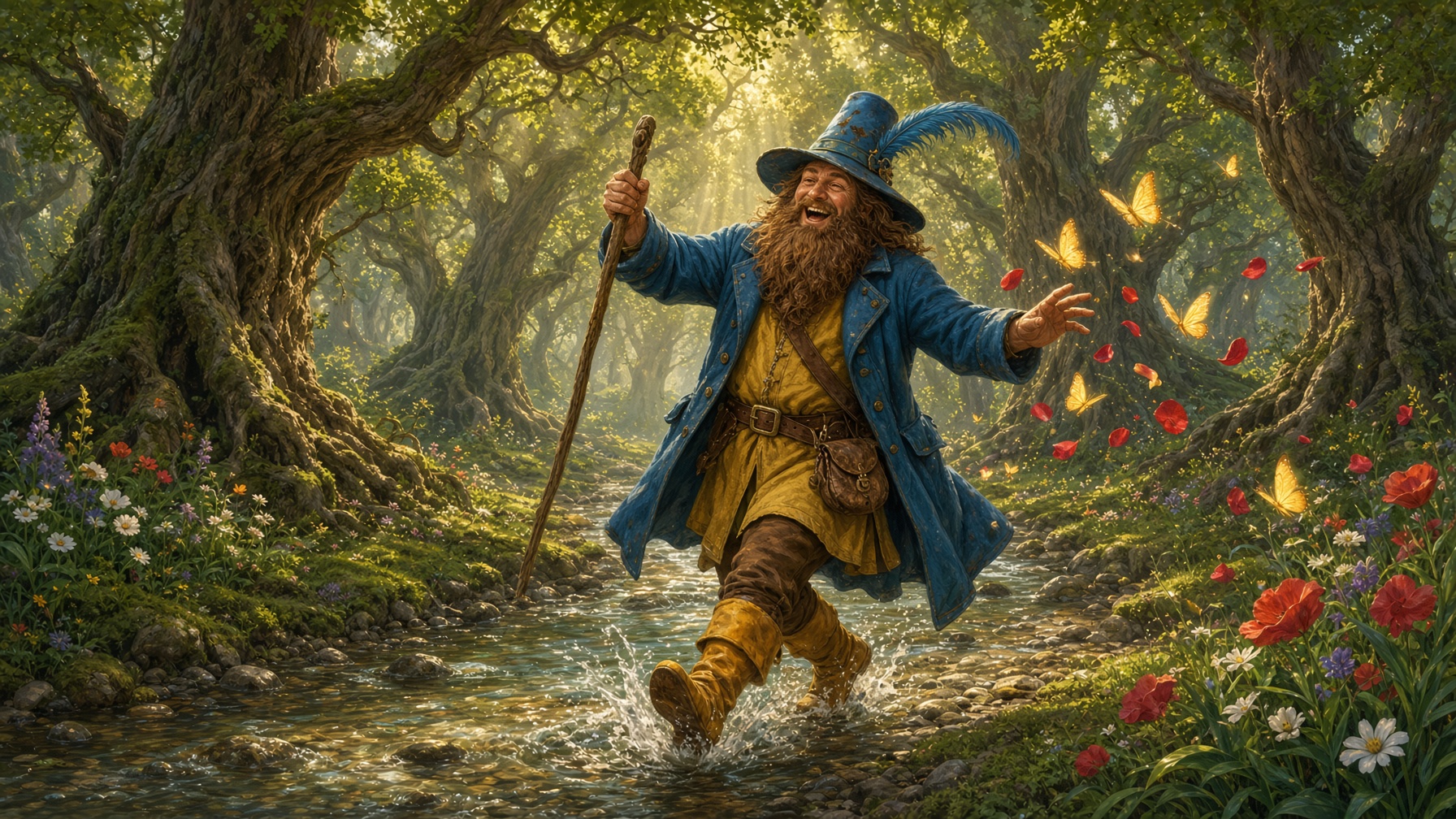
Our first encounter with him is one of pure, joyful chaos. The Hobbits are trapped, about to be crushed by the ancient, malevolent tree known as Old Man Willow. When all hope seems lost, they hear a song. A nonsensical, happy, and utterly commanding song. And then he appears: a stout fellow in a blue jacket, yellow boots, and a tall, weathered hat with a swan’s feather.
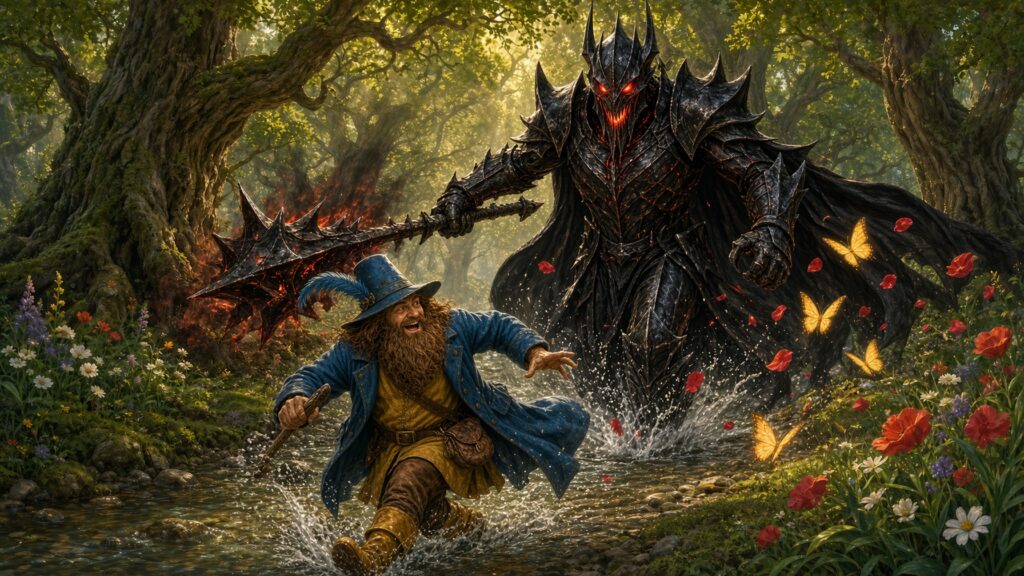
He doesn’t fight the ancient willow; he scolds it. He sings to it, commands it to release the hobbits, and the ancient, hostile tree obeys without question. This is our first clue: Tom Bombadil has a kind of absolute power within his own domain. He isn’t a warrior; he’s a master. Later, he saves the hobbits again, this time from the Barrow-wights, terrifying spectral beings. And once more, a song is his only weapon, and the darkness flees from his voice.
He describes himself in the most profound and simple terms. When Frodo asks who he is, Tom replies: “Eldest, that’s what I am… Tom was here before the river and the trees; Tom remembers the first raindrop and the first acorn.” This isn’t just a claim of being old; it’s a claim of being primordial, a being who existed before the world took its current shape.
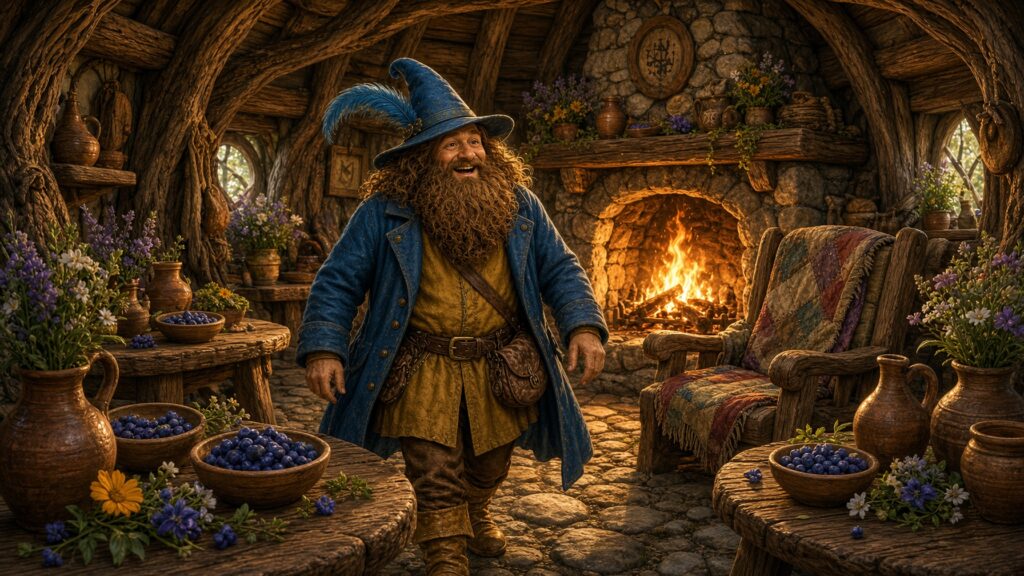
But the truly mind-bending revelation of his nature comes at his house. Frodo, finally feeling safe, explains the terrible burden he carries: the One Ring. He shows it to Tom. What happens next breaks every established rule of Tolkien’s world.
Tom asks to see the Ring and, against all instinct, Frodo just hands it over. Tom looks at it, a glint of amusement in his eyes. He puts the Ring on his finger… and nothing happens. He doesn’t vanish. He just stands there, laughing, and then makes the Ring disappear, only to pull it from his other hand like a cheap parlor trick.
Let’s pause to really appreciate this moment. The Ring is the focal point of all power and corruption in Middle-earth. It is the very essence of Sauron’s will to dominate. It tempts Gandalf, Galadriel, and Aragorn. It twists and consumes the minds of nearly everyone it touches. Yet, for Tom Bombadil, it’s a toy. A bauble. It has no power over him.
Then, when a shaken Frodo puts on the Ring to vanish from Tom’s sight, Tom can still see him. He calls out, telling Frodo to take off his “pretty ring,” revealing that not only is he immune to its power, but its power is also useless in his presence.
At the Council of Elrond, this immunity is a major topic. Erestor suggests they give the Ring to Bombadil to hide. But Gandalf shoots the idea down, and his reasoning is key. He says, “Say rather that the Ring has no power over him. He is his own master.” Gandalf understands that Tom’s immunity doesn’t come from some greater power, but from a complete and total lack of interest in what the Ring offers. The Ring promises power, and Tom has no desire for it. Gandalf concludes Tom would be an unsafe guardian, not because he could be corrupted, but because he’d likely forget the Ring or just toss it away, not understanding its significance to the rest of the world.
This is the Bombadil of the books. A being of immense, localized power, seemingly as old as the world itself, who is utterly outside the central conflict of good-versus-evil that defines the entire age. He is a paradox. And it’s from this paradox that all the theories are born.
The Investigation – Major Theories
The mystery of Tom Bombadil has become a favorite proving ground for Tolkien theorists. Over the decades, a few key ideas have risen to the top, each trying to fit this very square peg into the round holes of Middle-earth’s cosmology. Let’s break down the most prominent ones.
Theory Number One: Tom Bombadil is a Maia (or even a Vala)
This is often the first stop for many readers. The Valar are the god-like beings who shaped the world, and the Maiar are their powerful, angelic servants. Gandalf, Saruman, and Sauron are all Maiar. So, with his incredible power, could Tom be one of them?
At first, the evidence seems promising. His mastery over the Old Forest could be a form of Maiar power, just like how the Maia Melian protected the forest of Doriath. If he were a Maia, it would explain his long life and supernatural abilities without breaking the established divine order.
But the theory quickly falls apart. Every other Vala or Maia we meet is deeply invested in the fate of Middle-earth. They are agents of a cosmic plan, for good or for ill. Tom, on the other hand, is completely unconcerned with the world outside his borders. The war against Sauron is not his fight. He is defined by his indifference to the grand struggle.
More importantly, at the Council of Elrond, Gandalf, who is a Maia, speaks of Tom as something utterly unique. If Tom were one of the Valar or a fellow Maia, it’s almost certain that Gandalf or Elrond would have known it. They don’t treat him as an unknown, but they can’t place him in their catalogues of the world’s beings. He’s something else. So, while tempting, the Maia theory just doesn’t quite fit.
Theory Number Two: Tom Bombadil is the Spirit of Nature
This is probably the most popular and poetically fitting theory. In this view, Tom isn’t a divine being from outside the world, but is the world itself, or at least a piece of it, given a body and a voice. He is the genius loci, the spirit of the place, specifically of the ancient, untouched part of Middle-earth that the Old Forest represents.
The evidence for this is strong. His power is explicitly tied to his land. He tells the Hobbits they’re safe with him as long as they are within his borders. His wife, Goldberry, is the “Daughter of the River.” His whole life seems bound to the natural world. He remembers the first raindrop and acorn because, in a way, he is the memory of the land.
His immunity to the Ring also makes perfect sense here. The Ring represents the desire to dominate and control the world, a tool of industry and will. How could you tempt the forest itself with a promise of power over the forest? It’s a logical absurdity. Tom is master because he desires nothing from the land but to be part of it. He exists in a state of harmony that the Ring, a symbol of discord, simply cannot touch.
Tolkien himself once described Tom as the “spirit of the (vanishing) Oxford and Berkshire countryside,” tying his origin to a deep love for the natural English landscape. This theory feels right because it aligns so perfectly with Tolkien’s own deep ecological themes that run through all his work.
Theory Number Three: Tom Bombadil is Eru Ilúvatar
This is the most extreme and, for scholars, the most easily debunked theory. The idea is that Tom Bombadil is a direct incarnation of Eru Ilúvatar, the one, supreme creator God of Tolkien’s universe.
Proponents point to Goldberry’s cryptic answer when Frodo asks who Tom is. She simply says, “He is.” For some, this echoes the divine name “I Am that I Am” from the Old Testament, suggesting Tom is the ultimate being. His apparent omnipotence in his domain and his effortless dismissal of the Ring could be seen as proof of his supreme status.
However, Tolkien, a devout Catholic, flatly and repeatedly rejected this idea in his letters. He stated there is no “embodiment” of the Creator anywhere in his mythology; Eru remains distant and transcendent. Tolkien even said that readers making the “He is” connection were missing the point entirely.
Plus, Tom Bombadil’s power is fundamentally local and limited. It fades outside his borders. The idea that the omnipotent creator of the entire universe would be unable to act beyond a small forest is a contradiction Tolkien never would have endorsed. This theory, while grand, is built on a foundation the author himself demolished.
Theory Number Four: Tom Bombadil is an Allegory for the Reader or Author
This is a more meta idea, but it’s an interesting one. This interpretation suggests that Tom isn’t a character in the story in the same way as the others. Instead, he represents an observer who is outside the narrative’s direct influence.
Some see him as an avatar for Tolkien himself. A figure who can enter the story and interact with it but isn’t bound by its rules. His immunity to the Ring, in this reading, is a symbol that the story, no matter how dark, cannot harm its creator. The world and its conflicts are, to him, just a story.
Others see him as representing the reader. We, like Tom, observe the Ringbearer’s journey. We feel the tension and fear, but the Ring’s power can’t actually reach out from the page and corrupt us. We are in the world, but not of it. We are “masters” in our own way, able to put the book down whenever we want.
While Tolkien did write that the story was at “no point” about him, this allegorical reading still holds a certain power. It speaks to the strange relationship between a fictional world and our own, and the odd space a character like Bombadil occupies. He doesn’t fit the rules of Middle-earth because, maybe, he isn’t playing the same game.
The Author’s Intent
After sorting through all the theories, we’re still left with the main question: if Tom isn’t a Maia, or God, or a nature spirit, what is he? To find the real answer, we have to turn to the architect of Middle-earth himself. What did J.R.R. Tolkien say about his most baffling creation?
The truth is, Tom Bombadil wasn’t a puzzle Tolkien wanted us to solve. He was, from the very beginning, an intentional enigma.
In his letters, Tolkien was remarkably upfront about this. He told one reader, “I don’t think Tom needs philosophizing about, and is not improved by it.” He knew fans were desperate to stick a label on Tom, and he gently resisted.
He explained why in a now-famous letter: “As a story, I think it is good that there should be a lot of things unexplained… And even in a mythical Age there must be some enigmas, as there always are. Tom Bombadil is one (intentionally).”
This is a profound statement about world-building. Tolkien knew that a world that’s completely explained, where every mystery is solved, feels smaller and less real. Our own world is full of things we don’t understand. A truly believable fictional world, he argued, must have them too. Tom Bombadil is one of those enigmas. He’s the wild card, the element that doesn’t quite fit, and that’s what makes the world feel bigger than the story being told.
Tolkien admits that Bombadil is an odd fit. The character existed long before The Lord of the Rings, first appearing in a 1934 poem based on a Dutch doll owned by his children. When writing The Fellowship of the Ring, Tolkien needed an adventure for the hobbits on their way to Rivendell and decided to drop his pre-existing character into the story.
He acknowledged this was a bit awkward, but he defended it, writing that “in any universe devised imaginatively… there is always some element that does not fit and opens as it were a window into some other system.” Tom Bombadil is that window. He hints at a wider, stranger reality beyond the epic conflict between Sauron and the free peoples of Middle-earth.
His immunity to the Ring was also a deliberate philosophical point. Tolkien said that Tom Bombadil represents a pacifist, non-interventionist view of the world. The spirit that desires knowledge of things for their own sake, with no thought of “doing” anything with it. He’s not concerned with power or domination, so the Ring, the ultimate tool of domination, is meaningless to him. He’s a living statement that even in a world defined by a war for its very soul, some things remain unconcerned, existing on their own terms.
So, the “truth” of Tom Bombadil isn’t his identity. His purpose is to be a mystery. He is Tolkien’s deliberate reminder that no map can ever fully represent the territory, and no story can ever contain the whole world.
The Thematic Importance – The Guite Reflection
So, if Tolkien’s final word is that he’s an “intentional enigma,” is that where the story ends? Not quite. Because the most important question isn’t what he is, but why a figure like him matters. For that, we can turn to modern thinkers who carry Tolkien’s legacy forward, like the poet and scholar Malcolm Guite.
Guite sees figures like Bombadil not as plot holes, but as essential parts of a deep mythology. His perspective helps us understand the profound role such mysteries play. Guite has spoken of Tom Bombadil as representing something ancient and rooted, a kind of unfallen spirit of the earth itself, connecting him to the themes of landscape and beauty that are so central to Tolkien’s work.
In Guite’s view, Bombadil embodies a kind of pre-lapsarian, unfallen joy. He doesn’t analyze the water-lilies, he delights in them for his beloved Goldberry. He doesn’t seek to control Old Man Willow, he simply lives alongside him, asserting his mastery only when the natural order is disturbed. He represents a kind of deep, ancient innocence of the earth itself, which predates the struggles for power that came with the “Big People.”
This is where Guite’s insight becomes so powerful. He helps us see that Bombadil’s resistance to a simple explanation is his greatest strength. In a story obsessed with power, lineage, and purpose, Tom stands apart. He has no grand destiny. He isn’t trying to save the world. He is simply, joyfully, himself. He is master of his small country because he desires nothing more than what he already has.
This provides a vital counterpoint to the logic of the Ring. The Ring operates on desire, ambition, and the will to power. It promises the means to achieve your ends. But what can it offer a being who is completely content? A being whose entire existence is defined by joy and song? To Tom, the Ring isn’t a source of ultimate power, but a meaningless trinket, because its currency, domination, is worthless in his economy of delight.
Guite’s reflections frame Bombadil as a challenge to our modern, utilitarian way of thinking. We, like the elves and men at the Council of Elrond, want to use him. We want him to be a weapon, a guardian, a tool. But he refuses to be instrumentalized. He cannot be categorized because he is not a means to an end; he is an end in himself.
This is why he’s so important. He reminds us that there are things in the universe that exist outside our struggles and our understanding. There are realities that do not bend to our will, no matter how righteous our cause. Bombadil represents the sheer, stubborn, and joyful “is-ness” of creation. He is the song the world sings to itself when no one is listening.
By embracing Bombadil as a mystery, Tolkien, and later interpreters like Guite, teach us a crucial lesson. Some things aren’t meant to be solved, categorized, or controlled. They are meant to be encountered, wondered at, and celebrated for their very inexplicability.
Conclusion
In the end, after all the theories have been laid out and all the letters read, we are left where we began: with a song in the Old Forest and a merry fellow in yellow boots. The quest to uncover the “truth” of Tom Bombadil leads us to a conclusion that is both simple and profound: his truth is that he is a secret.
He’s not a puzzle to be solved, but a presence to be felt. He is Tolkien’s deliberate challenge to the reader who wants everything explained, a vibrant splash of inexplicable color on the grand tapestry of Middle-earth. He is the embodiment of a world that is deeper, older, and stranger than any one story can contain. He is the reminder that outside the epic struggles for power and the shadow of impending doom, there is still song, laughter, and the simple joy of being. He represents a freedom so complete it cannot even be tempted by absolute power.
He is his own master. And perhaps, in a world that constantly asks us to be something for someone else, that is the most powerful thing anyone can be.
But that’s just our journey through the evidence. The beauty of a mystery like this is that it belongs to every reader. So now I turn the question over to you. What does Tom Bombadil represent to you?