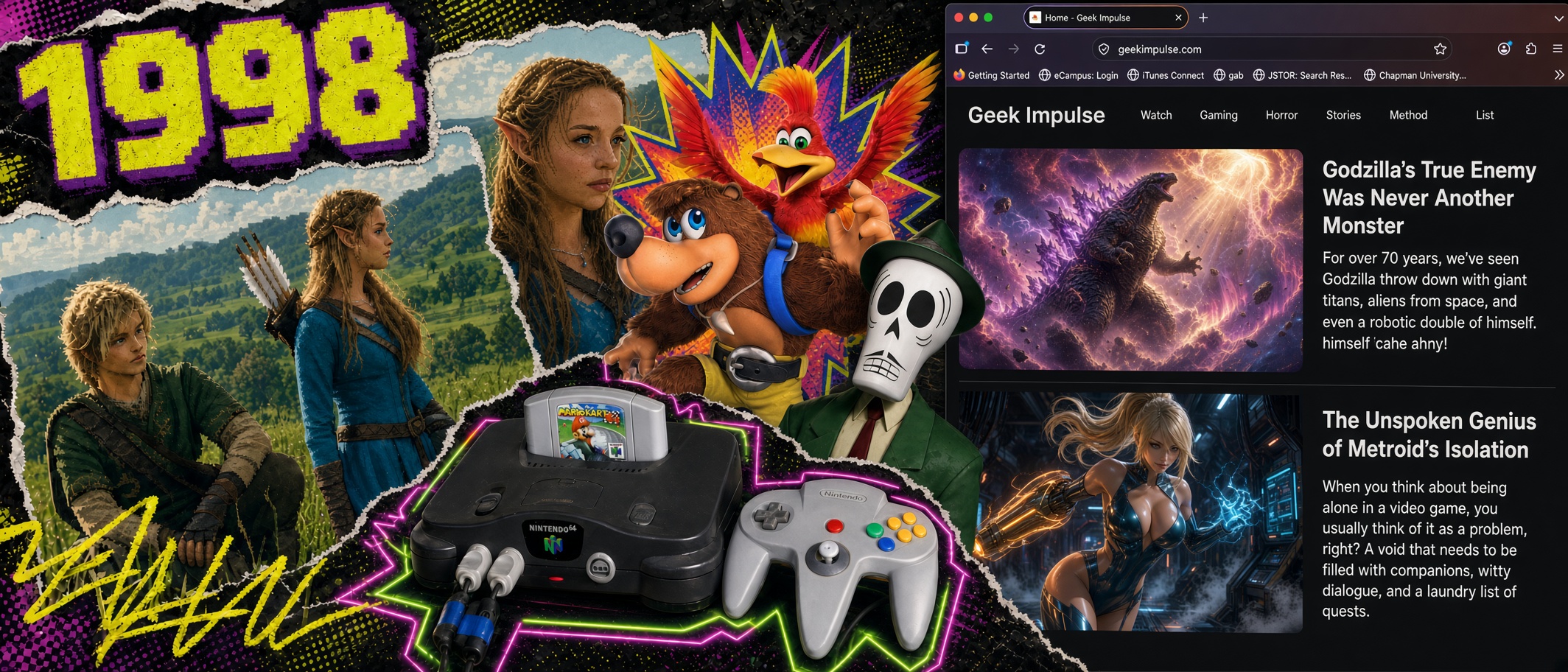
It’s the year that gave us the Hero of Time, Gordon Freeman’s very bad first day at the office, and the birth of Solid Snake’s cinematic legacy. For decades, you’ve heard the story. You’ve seen it repeated in forums, in comment sections, and in retrospective videos. The story goes that 1998 was, without a doubt, the single greatest year in the history of video games. An undisputed, untouchable golden age.
But what if that’s just a story? What if our collective memory of 1998 is built on a handful of truly revolutionary classics, while we conveniently forget the hundreds of other games from that year that were… well, pretty forgettable?
Today, we’re taking off the nostalgia goggles. We’re going to look past the giants to see the messy, awkward landscape they stood on. We’re here to ask: is 1998’s golden reputation truly deserved, or is it an illusion we’ve all agreed to believe in?
Acknowledging the “Why,” The Foundation of the Myth
Before we can challenge the legend, we have to understand why it exists. The argument for 1998’s greatness doesn’t come from nowhere. It comes from a small group of games so innovative and so perfectly executed that they didn’t just define their year; they defined the future of their genres. These are the titans that carry the entire year on their shoulders.
Let’s start with the big one: The Legend of Zelda: Ocarina of Time. To this day, it sits at the top of Metacritic’s all-time rankings with a legendary Metascore of 99. While there’s some modern debate about whether the math behind that score should be a 98, its monumental status is undeniable. Before Ocarina, 3D adventure games were still figuring things out. Nintendo didn’t just write a chapter in the rulebook; they wrote the whole thing. Z-targeting was a revelation, an elegant solution for combat and interaction in 3D space that countless games would copy. But it was more than mechanics. It was the feeling of galloping across a vast Hyrule Field, the shift from a world of light to a world of shadow, and the genius dungeon design. Ocarina of Time became the benchmark.
Then, there was Half-Life. While other shooters were still about finding color-coded keycards, Valve built one of the most immersive experiences ever. Half-Life‘s genius was its uninterrupted first-person perspective. No cutscenes. The story happened to you, through the environments, the screams of scientists, and the radio chatter of soldiers. It treated you like a character, Gordon Freeman, not just a floating gun. This focus on environmental storytelling was a paradigm shift.
And you can’t talk 1998 without Metal Gear Solid. Hideo Kojima’s masterpiece didn’t just make stealth games popular; it fused them with the ambition of a Hollywood blockbuster. It was a game that thought about things other games didn’t, from fourth-wall-breaking boss fights to a story about nuclear proliferation and genetic destiny. The gameplay itself is a tense loop of observation and infiltration that was just as revolutionary.
These three are the holy trinity of 1998, but the list goes on. It was the year Blizzard perfected real-time strategy with StarCraft, a masterclass in asymmetrical faction design that’s still relevant. It was the year Capcom redefined survival horror with Resident Evil 2, perfecting the template of scarce resources and claustrophobic tension. And for RPG fans, there was Baldur’s Gate, a sprawling D&D campaign brought to the PC with staggering fidelity. It’s an embarrassment of riches. These games aren’t just good “for their time,” they are foundational pillars of modern gaming. With a lineup like that, how could 1998 be anything but the greatest? Well, this is where it gets complicated.
The “But…” The Great Forgotten Majority
The story of 1998 that we love to tell is really the story of about five to ten landmark games. We pin the whole year’s reputation on this tiny, elite group. But the story isn’t just about the games we remember; it’s about the hundreds of games we’ve all collectively decided to forget. For every Half-Life, there were dozens of derivative shooters. For every Ocarina of Time, there were countless clumsy, awkward 3D adventure games.
This is where the myth starts to crack. When you zoom out from the masterpieces, the “average” game from 1998 looks very different. Remember Rascal? It was a 3D platformer with a camera so notoriously bad it made the game almost unplayable. How about Gex: Enter the Gecko? A perfectly fine platformer at the time, but its pop-culture jokes are painfully dated now, and the gameplay feels incredibly repetitive. Or consider Body Harvest, a game with huge ambition from the studio that would become Rockstar North. An open-world, vehicle-based shooter! But its clunky controls and foggy graphics made it a frustrating glimpse of the greatness that would later come with Grand Theft Auto III.
And listen, these weren’t all “bad” games on release. Many got decent reviews. They were just products of a chaotic, experimental era when developers were still wrestling with the basics of 3D. Controls were often stiff. Cameras frequently had a mind of their own. Developers were fighting the hardware, resulting in worlds that felt empty, foggy, and populated by blocky, low-poly models.
The “greatest year” story conveniently ignores this ocean of mediocrity. It smooths over the rough edges and pretends the year was a non-stop parade of hits. The reality is that 1998 wasn’t a masterpiece factory; it was a minefield of design dead-ends and technical hurdles, with a few brilliant explosions that showed everyone the way forward.
So why do we overlook this? One simple word: nostalgia. For many of us, 1998 wasn’t just a year; it was a time in our lives. We were younger. These were the games we got for a birthday or rented for a weekend. Our memories of them are tied to our personal experiences.
That feeling of stepping into Hyrule Field for the first time wasn’t just about the game; it was about the novelty of it all. The world of 3D was still so new. A big, open field, even one that seems a bit empty by today’s standards, felt like a technical miracle. This “wow” factor is a huge part of the 1998 experience, and it’s something that can never be replicated.
When we talk about “nostalgia goggles,” this is what we mean. It’s a filter that makes the colors brighter and smooths over the flaws. It helps us remember the awe but forget the frustration of a wonky camera. It’s why going back to a childhood favorite can be so jarring. The game hasn’t changed, but we have. Our standards have.
And that brings us to the final, toughest part of this conversation: playing these games today. This isn’t about saying these games are “bad.” It’s about separating their historical importance from their modern playability. Take tank controls. In the original Resident Evil 2, the slow, deliberate movement was a key part of the horror. It made every encounter tense because you couldn’t just whip around to face a zombie. But for anyone used to modern games, it can feel incredibly archaic sort of a barrier, not a feature.
Even the mighty Ocarina of Time isn’t immune. That revolutionary Hyrule Field can feel sparse compared to modern open worlds. The pacing, especially in the first few hours, is notoriously slow. Some of the puzzles are so cryptic they practically required you to own the player’s guide.
We see this pattern everywhere. Banjo-Kazooie is a brilliant platformer, but it’s also a “collect-a-thon,” a design style that many now feel is just busywork. Spyro the Dragon, while charming, is mechanically simple. Final Fantasy Tactics, praised for its deep strategy, has a user interface that would make a modern player want to tear their hair out. These games are still great, but you have to meet them on their own terms, accepting the limitations of their time. They are, in a sense, era-locked.
Conclusion
So, is the legend of 1998 a complete lie? No, not at all. It’s more like a partial truth, an exaggeration born from undeniable brilliance. 1998 was absolutely a landmark year for video games. It was a year of explosive creativity and technological leaps that laid the groundwork for everything we play today. The masterpieces of 1998 aren’t overrated; they deserve their place in the pantheon.
But the myth of the “greatest year ever” asks us to do more than celebrate the peaks; it asks us to ignore the valleys. It wants to flatten a whole messy, complicated year into a highlight reel of five or six games. It wants us to forget the awkward experiments and the outright failures. It wants us to believe the whole year was a golden age, when really, the gold was just concentrated in a few brilliant spots.
The year’s reputation is a story we tell ourselves about a time when everything felt new and the possibilities seemed endless. It’s a story about giants like Zelda, Half-Life, and Metal Gear Solid—titans so huge they cast a shadow that, over time, we mistook for the entire landscape.
Questioning the myth of 1998 isn’t about tearing down our heroes. It’s about seeing the past more clearly. It’s about understanding that progress is always a messy process of trial and error. 1998 was extraordinary, but its greatness came from a few towering classics that showed us the future, not from every single game released in that 12-month window. And honestly, that’s a much more interesting story to tell.
But that’s our my take. What do you think? Was 1998 truly gaming’s peak, or are we all just looking back with rose-tinted glasses?