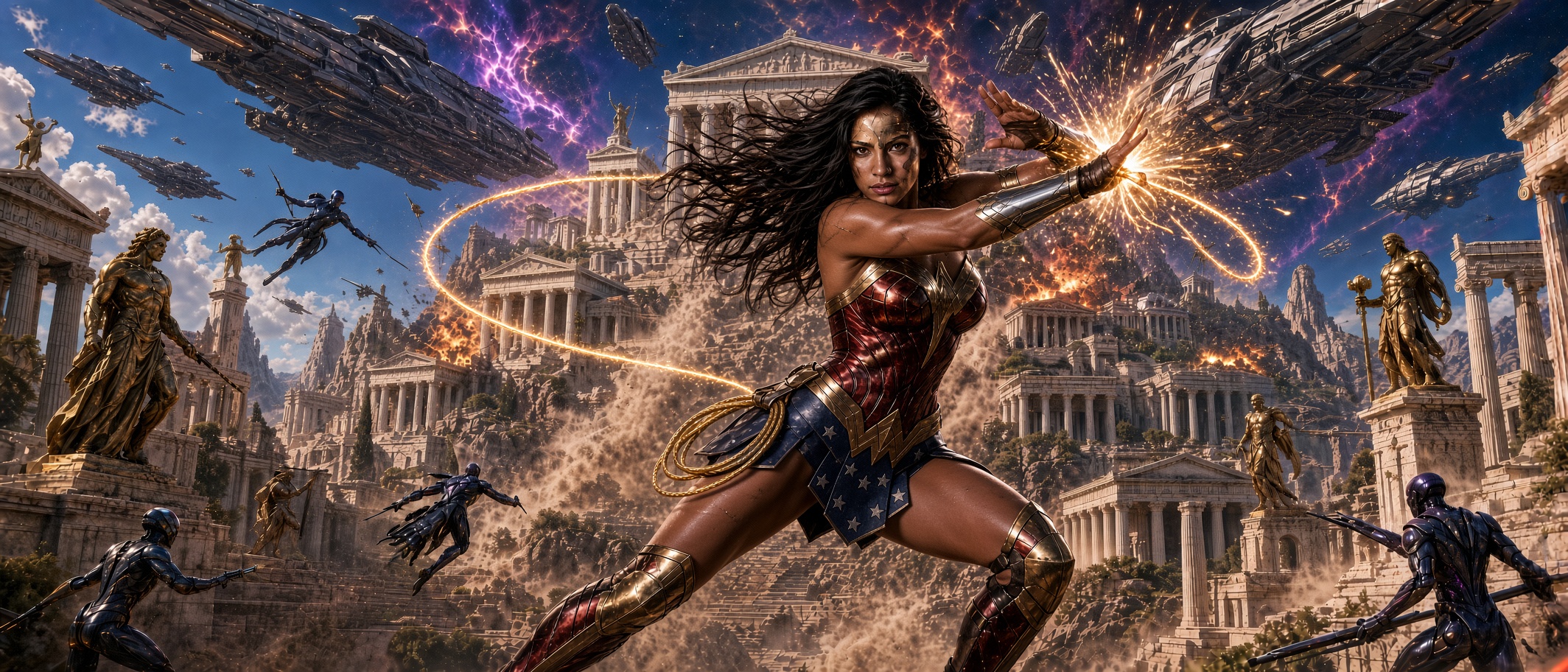
We see them as modern creations, products of comic books and blockbuster movies, born in the 20th century. But what if I told you that we’ve been telling stories about them for thousands of years? It’s an argument made by scholars and fans alike: that from Wonder Woman’s Amazonian heritage in Greek legend to Superman’s striking parallels with ancient figures, superheroes are the modern myths of our time. This is the story of how the gods of old may have never really left us… they just put on a cape.
The Modern Myth
Since the dawn of civilization, humanity has crafted stories of extraordinary beings. Gods, monsters, and heroes who wrestled with cosmic forces and embodied our greatest hopes and fears. These myths weren’t just entertainment; they were a culture’s way of understanding the world and its own values. Today, it can be argued that comic books and superhero films serve a similar function. They are a modern canvas for our ancient archetypes.
These narratives present larger-than-life protectors who grapple with morality, justice, and their place in the world. They are symbols of strength, hope, and sacrifice. And when you look closely, you’ll find that the blueprints for these modern icons can be traced back to the legends of old. The characters are different, the costumes are brighter, but the fundamental stories, the archetypes, remain surprisingly consistent. So let’s pull back the mask and explore the mythological DNA of the heroes we worship today.
The God Who Walks Among Us
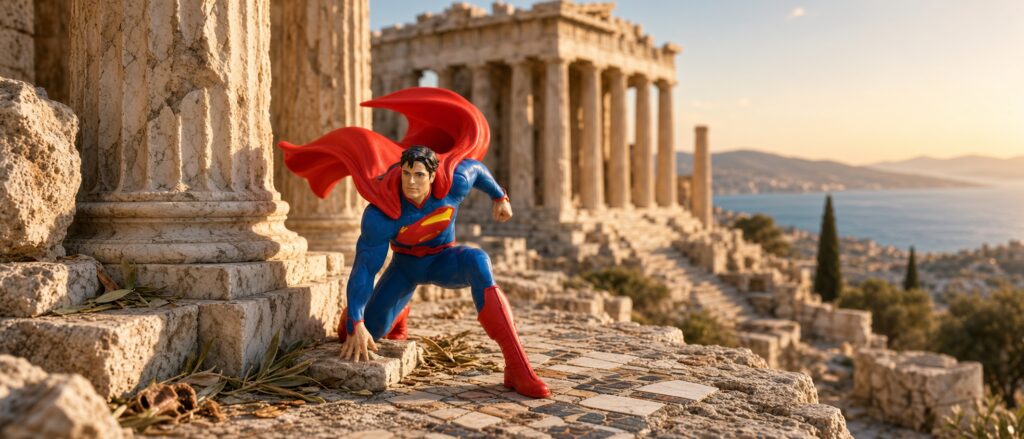
The idea of a divine being coming to Earth from the heavens is one of the oldest stories we have. A being who walks among mortals, possessing powers beyond our comprehension. In Greek mythology, Zeus certainly interacted with mortals, though often in morally questionable ways, but other traditions had figures who acted as saviors and protectors.
Now, let’s start with the big guy: Superman. Created in 1938 by Jerry Siegel and Joe Shuster, his official origin is science fiction: the sole survivor of the doomed planet Krypton. But the mythological echoes are hard to ignore. His birth name, Kal-El, has been interpreted by some scholars to connect to Hebrew, with “El” being a name for God, though this is a subject of debate.
More overtly, his origin story strongly echoes the story of Moses: a baby placed in a vessel by his parents and sent away to escape destruction, only to be found and raised by others to become a great protector.
Like many ancient gods, Superman’s power feels elemental. He is famously powered by Earth’s yellow sun, a detail that invites comparisons to solar deities of ancient myth. He possesses god-like strength and the ability to fly, setting him apart from and above humanity. He even resides in a “Fortress of Solitude,” an isolated sanctuary not unlike Mount Olympus.
This connection to divinity becomes even more pronounced in one of his most famous storylines from the 1990s. After being killed in a cataclysmic battle with the monster Doomsday, Superman eventually returns, reviving in a Kryptonian regeneration matrix within the Fortress of Solitude. This narrative of death and rebirth mirrors the myths of dying and rising gods found across many ancient cultures, solidifying his role for many readers as a modern symbol of hope and renewal.
The Warrior from a Lost World
Of all the heroes in modern comics, none has a more direct and deliberate connection to ancient mythology than Wonder Woman. While Superman’s links are interpretive, Wonder Woman’s story is explicitly built from the foundations of Greek legend. Her creator, William Moulton Marston, first introduced her in 1941, rooting her firmly in the mythology of the Amazons.
In Greek mythology, the Amazons were a formidable tribe of warrior women, though their stories vary across different ancient texts. Marston took this concept and created Themyscira, also called Paradise Island, a utopian society of women tasked with being a beacon of peace and wisdom.
However, Wonder Woman is not just a copy-and-paste from mythology. Her character is a unique blend of ancient legend and Marston’s own 20th-century ideas. This is clear in her evolving origin. In her classic story, she was sculpted from clay by her mother, Queen Hippolyta, and given life by the Greek goddesses. But in a major 2011 revision for the “New 52” comics line, she was reimagined as a demigod, the biological daughter of Hippolyta and Zeus, the king of the gods. This change, however, has itself been altered in later versions, with some storylines returning to the clay origin.
This potential divine parentage makes her a peer of mythological heroes like Hercules and Perseus. In some versions of her story, her powers are literal gifts from the gods: her strength from Demeter, her wisdom from Athena, and her speed from Hermes. Her iconic equipment is also steeped in myth. In one telling, her indestructible bracelets were fashioned from the remnants of Athena’s legendary shield, the Aegis. And her most famous weapon, the Lasso of Truth, which compels anyone bound by it to speak the truth, reflects her role as a champion for justice. She is a warrior, a diplomat, and a princess, a direct bridge between the ancient world of myth and the modern world of superheroes.
The Mortal Who Touches Divinity
Another enduring mythological archetype is the mortal who, through great trials or divine blessings, ascends to a status bordering on godhood. The most famous example is the Greek hero Heracles, or better known by his Roman name, Hercules. Born a demigod with incredible strength, Heracles undertook twelve impossible labors, a journey that ultimately led to his apotheosis, his transformation into a true god.
This pattern of a mortal gaining the power of the gods is a fantastic blueprint for one of DC Comics’ most powerful heroes. Created in 1939, this hero was originally known as Captain Marvel. Today, due to trademark issues, he’s better known by the magic word that gives him his power: Shazam. He is the alter-ego of a young boy, Billy Batson, who is chosen by an ancient wizard to be a champion for good. By speaking the word “SHAZAM!”, Billy is struck by mystical lightning and transformed into an adult superhero.
The name itself is an acronym, granting him the powers of six legendary figures: the wisdom of Solomon, the strength of Hercules, the stamina of Atlas, the power of Zeus, the courage of Achilles, and the speed of Mercury. It’s a fascinating mix of a biblical wise man, Greek and Roman gods, a Titan, and a legendary warrior, a whole pantheon of power in a single hero.
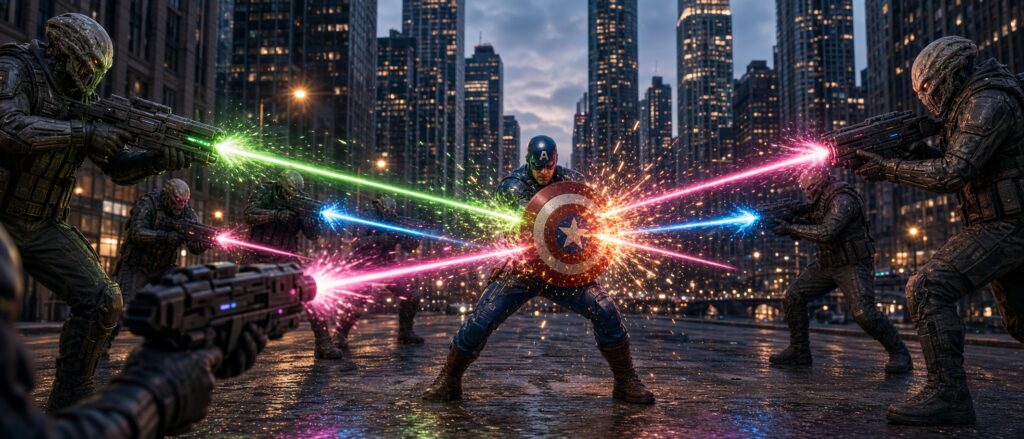
A more metaphorical version of this can be seen in Marvel’s Captain America. Created by Joe Simon and Jack Kirby in 1941, Steve Rogers starts as a frail young man who, through the Super-Soldier Serum, is transformed into a state of physical perfection. While he doesn’t have magical powers, his transformation is often seen as a kind of secular apotheosis, a mortal man raised to a level that borders on the mythic. He becomes a living symbol, embodying an ideal. The creators chose a man who was already good and made him strong, suggesting that true heroism comes from character, not power.
The Beast Within and the God of Wrath
Not all myths are about perfect, shining gods. Many ancient stories explore the darker, more destructive aspects of power like primal rage, uncontrollable strength, and the duality of man and monster. Norse legends spoke of the berserkers, warriors who entered a trance-like fury in battle, while some Jewish folklore tells of the Golem, a powerful being animated from clay, often as a protector, but one that could become dangerously mindless.
This archetype finds its modern home in The Incredible Hulk. The Hulk’s origin is a cornerstone of the Marvel Age: during a gamma bomb test, the brilliant but reserved scientist Dr. Bruce Banner absorbs a massive dose of gamma radiation. The result is a transformation. Triggered by rage or extreme stress, Banner becomes the Hulk, a being of near-limitless strength and primal fury.
Stan Lee, one of his creators, acknowledged the Hulk’s connection to figures like Frankenstein’s monster and Dr. Jekyll and Mr. Hyde. The story also carries strong echoes of the Golem, as Lee himself has compared the Hulk to the figure from Jewish mythology. Like the Golem, the Hulk can be seen as a protector born from tragedy, a powerful force that is not inherently evil but is frighteningly uncontrollable.
Over decades of stories, this mythological status has even been referenced within the Marvel universe. In the comic Immortal Hulk #47, a powerful Thor confronts the Hulk and refers to him not as a monster, but as “Midgard’s God of Wrath.” While this is Thor’s perspective in a specific storyline and doesn’t make the Hulk a literal god, it’s a powerful acknowledgment of his elemental, mythic status. He represents a force of nature, a living embodiment of rage as terrifying as any ancient god of destruction.
Conclusion
From the alien savior who echoes the story of Moses, to the Amazonian princess born from Greek myth, to the mortals who are granted the power of gods, the thematic connections are striking. Superhero stories seem to suggest that we have a fundamental need for mythology. We need tales of beings greater than ourselves who can fight the battles we cannot and who embody our highest ideals.
The names and costumes may have changed. Science fiction has often replaced magic. But the core archetypes such as the stranger from the sky, the virtuous warrior, the human who becomes more, remain. These characters suggest that while our technology and culture evolve, our fascination with power, morality, and heroism is timeless. Perhaps we never stopped needing myths; we just learned how to draw them ourselves, giving them new names and new worlds to save.