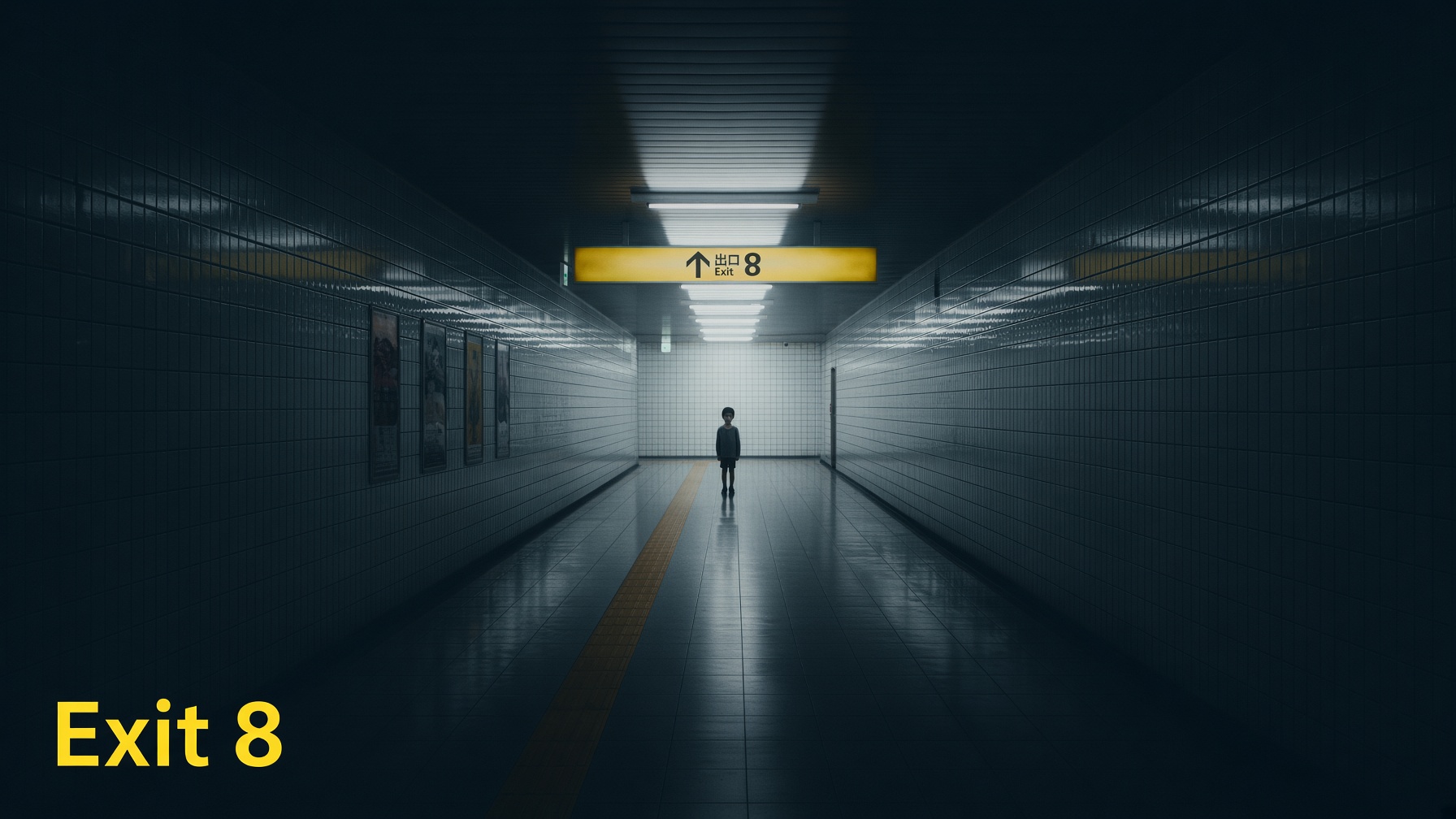
You walk down a hallway. You spot a weird poster. You turn back. You do this eight times, and you’re free. That’s Exit 8, isn’t it? A simple, spooky ‘spot the difference’ game.
But what if I told you that’s not really the game at all? What if the looping subway, that strange man who passes you, and the exit itself are all part of a deep, hidden metaphor about the moments in our own lives when we choose to look away? What if the real game in Exit 8 isn’t about finding what’s wrong with the hallway, but what’s wrong with the person walking down it?
The Shared Experience & The Unanswered Question
For anyone who’s played the 2023 indie hit The Exit 8, the idea is brutally simple. You’re trapped in a sterile, fluorescent-lit Japanese subway corridor. The rules are clear: if you look around and see nothing out of the ordinary, you walk forward. If you spot an “anomaly,” anything from a misplaced doorknob to a wall of screaming faces, you have to turn back. Get it right eight times in a row, and you escape. Make one mistake, and you’re sent right back to Exit 0.
It’s a masterclass in building tension from repetition. That core idea was so strong that it was adapted into a feature-length psychological horror film in 2025. The movie, directed by Genki Kawamura, takes that simple “spot the difference” premise and builds a full-fledged story around it, giving the loop a purpose the game never spelled out.
But whether you’ve only played the game or seen the movie, there’s a question that sticks with you long after you’re done: why does it feel like there’s something more going on here? Why a subway? Why the number eight? And what’s the deal with that silent, occasionally smiling Walking Man who paces the halls with you? It turns out, these probably aren’t just random, spooky details. They seem to be carefully chosen puzzle pieces. And when you put them together, they suggest that Exit 8 isn’t a story about escaping a supernatural subway, it’s a story about escaping yourself.
Exhibit A – The Setting as a Metaphor
Let’s start with the most basic part of Exit 8: the setting. An endless, looping subway corridor isn’t just a convenient location for a horror game; it’s a powerful metaphor for a life stuck on repeat. It can be seen as representing indecision, avoidance, and the crushing routine of a life going nowhere.
This is where the film gives us the crucial context the game leaves to our imagination. The movie’s protagonist, called the “Lost Man,” isn’t just physically lost; he’s emotionally and morally adrift. We learn he’s in the middle of a personal crisis. His ex-girlfriend has called to tell him she’s pregnant, and his first instinct is to dodge the call, to put off the conversation. To literally run away. He’s also a passive observer in his own life, watching silently as a man berates a mother for her crying baby on the train, choosing to get lost in his music rather than get involved.
His life is a loop of inaction. So, the world seems to put him in a literal one.
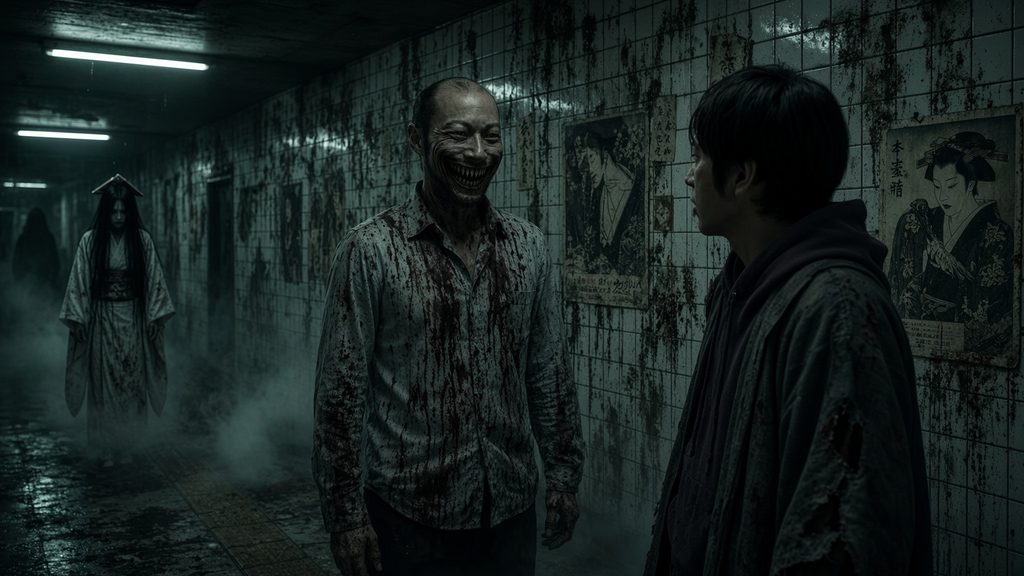
This interpretation is where the number eight becomes so significant. Turned on its side, the number 8 is, of course, the infinity symbol. It represents an endless cycle, a kind of purgatory where you walk the same path over and over, trapped by your own inability to change. The only way to break the cycle isn’t by walking faster or trying to force your way through, but by stopping, observing, and making a conscious choice. The hallway forces the Lost Man to do the one thing he’s been avoiding in his real life: pay attention.
The environment itself reinforces this idea of being trapped in a mental state. The clean, sterile, and maddeningly repetitive architecture feels less like a real place and more like a construct of the mind. It’s the visual representation of anxiety, of a brain stuck running the same worried thoughts over and over, searching for the one thing that’s out of place. In this reading, the subway is his personal hell, designed specifically to mirror the rut he has dug for himself.
Exhibit B – The Anomalies as Red Flags
If the hallway is a loop of avoidance, then the anomalies are the world screaming at him to wake up. They aren’t just random, spooky events; they can be interpreted as symbolic disruptions meant to force awareness. They represent the red flags in his own life that he’s been willfully ignoring.
Think about the nature of the anomalies. Some are subtle, like a poster that’s slightly off or a doorknob in the wrong place. These are like the small, nagging feelings that something isn’t right. The gnawing guilt you try to push down. In the game and the film, if you ignore these subtle signs and walk past them, you’re punished. You’re sent back to the start. The message seems clear: ignoring your problems, no matter how small, doesn’t make them go away. It just guarantees you’ll have to face them all over again.
Then there are the more aggressive, terrifying anomalies. The lights flicker and die. In the game, the hallway can begin to flood with blood, a visceral, impossible-to-ignore symbol of life, guilt, and consequence that seems to directly confront his fear of the pregnancy. The film opts for a less graphic version with rising floodwaters, but the threat is the same.
These anomalies function like externalizations of his internal state. That creeping sense of being watched, from the eyes on the security posters that follow him, feels like his own paranoia and guilt made manifest. The most dangerous anomalies are the ones that chase him, like the smiling Walking Man suddenly sprinting towards him. These represent the moments when the problem you’ve been ignoring finally catches up, becoming an active threat you can no longer outrun. The only way to survive is to turn around and confront the fact that something is deeply wrong.
Exhibit C – The Two Men
At the center of this psychological maze are two figures: the Lost Man and the Walking Man. In the film’s narrative, they can be seen as two sides of the same coin, representing a choice and its consequences.
The Lost Man, as we’ve established from the film’s plot, is the embodiment of passivity. His name says it all: he is lost, not just in a subway, but in life. The film shows us his life before the loop, a man who dodges the call that represents his future, who puts in headphones to drown out a moral conflict happening right in front of him. The loop is a trial designed to burn away this passivity. He is forced, again and again, to make a choice: Is something wrong, or is it right? Do I go forward, or do I turn back?
Then there’s the Walking Man. In the game, he’s a mysterious, unsettling presence. The film gives him a tragic backstory, revealing he was also a victim of the loop before the Lost Man arrived. He functions as a ghost of Christmas future, a warning of what the Lost Man might become if he fails this test. The Walking Man is presented as someone who chose wrong, who failed to confront his own problems, and is now doomed to walk this hallway forever, his face occasionally breaking into a terrifyingly vacant smile. He represents the ultimate anomaly: a person so lost that they’ve become just another feature of the endless corridor.
The Revelation – The “Aha!” Moment
This brings us to the central thesis, the “Aha!” moment where all the film’s added pieces click into place. Exit 8, at least in its movie form, is an allegory for confronting responsibility. The entire ordeal, the loop, the anomalies, the two men, is a psychological test. And the key to passing isn’t intelligence or speed, but empathy and action.
The ultimate proof of this lies in the film’s most critical sequence: the introduction of the Boy and the flood. Deep into his loops, the Lost Man encounters a small boy. At first, he thinks the boy is just another anomaly and turns back, only to be reset to zero. This is a profound moment. His self-centered focus on “solving the puzzle” makes him reject a human connection, and he’s punished for it.
He learns his lesson. The boy becomes his companion, and together they progress. Then, the hallway begins to flood. As the water rises, the Lost Man makes a choice. Instead of just trying to save himself, he lifts the boy onto his shoulders, protecting him. This is the turning point. It’s the first truly selfless act we see from him. He prioritizes another’s well-being over his own escape. In that moment, he stops being the Lost Man and starts becoming a father.
That act of responsibility is what seems to break the curse. Soon after, they reach the final exit. He has escaped the loop not by outsmarting it, but by proving he was ready to handle the responsibilities waiting for him on the other side.
The Aftermath – The New Perspective
Understanding this allegory completely changes the meaning of the ending. Reaching Exit 8 isn’t just about winning a game; it’s about graduating from a moral test. The escape from the subway isn’t a physical victory, but a spiritual one. The protagonist has been fundamentally changed.
The film’s final scenes provide powerful confirmation of this transformation. After emerging from the underground, the Lost Man finally accepts his role and moves forward. He gets on the train, ready to support his ex-girlfriend.
But the film gives us one last, brilliant test. He finds himself witnessing the exact same scene that started his journey: a man yelling at a mother with a crying baby. The first time, he looked away. This time, he doesn’t. He gets up and intervenes, confronting the man and defending the mother and child.
The loop is over, but the real test has just begun. The real Exit 8 wasn’t a staircase to the street; it was a choice. The final scene proves his change is real. He has integrated the lesson of the corridor into his life. The anomaly was never the smiling man or the bleeding walls. From this perspective, the true anomaly was his own inaction. By turning to face the problem instead of walking past it, he proves he has truly escaped. He has finally chosen the right path.
The layers in Exit 8 are incredibly deep, and this is just one interpretation of what it all means. So what did you think? Was the Lost Man’s journey a purgatorial test, or something else entirely? Let me know your theories down in the comments below. And if you enjoy these deep dives into the hidden meanings of your favorite games and movies, make sure to subscribe to our YouTube Channel, so you don’t miss our newest video.
The Lingering Thought

When you strip it all away, Exit 8 uses the language of liminal spaces and psychological horror to tell a profoundly human story. It’s about the hallways we build in our own minds when we’re afraid to face the future. It’s about the strange, unsettling feelings that creep into our lives when we refuse to deal with our own guilt and inaction.
The game gives us the unsettling feeling of being trapped. The film gives us a reason why. It’s a story suggesting that sometimes, the only way to move forward is to stop, turn around, and face the one anomaly you’ve been refusing to see: yourself. The most terrifying thing in that hallway isn’t a monster or a ghost. It’s the reflection of a person who keeps choosing to walk away. And the most triumphant moment is when they finally decide to turn back.