Hollywood’s first major attempt at a Nintendo movie was 1993’s Super Mario Bros. It was a legendary disaster so bad, it made the company deeply cautious about movies for nearly thirty years. Nintendo built a protective wall around its characters, vowing never again to let outsiders compromise their vision.
And now, we have this: a billion-dollar box office hit, and a live-action Legend of Zelda movie on the way, co-financed and controlled by Nintendo itself. This wasn’t an accident. It’s the result of a 40-year journey, a quiet revolution in their business strategy designed to finally conquer Hollywood on their own terms. And everything hinges on whether they can make this work. The stakes have never been higher, because The Legend of Zelda isn’t just another video game movie. It’s Nintendo’s crown jewel, and adapting it might be one of the hardest jobs in film history.
The Fortress of Solitude
To get why the Zelda movie is such a monumental gamble, you have to understand the trauma of that 1993 film. The Super Mario Bros. movie wasn’t just a flop at the box office; it was a creative catastrophe that seemed to fundamentally misunderstand, and maybe even resent, the source material. It was a dark, gritty, bizarre film that had almost nothing to do with the colorful kingdom it was based on. For a company like Nintendo, which is obsessed with quality and protecting its brand, it was the ultimate nightmare. The failure was so profound that it triggered a decades-long retreat from Hollywood.
For the next thirty years, Nintendo became fiercely protective of its properties. While other companies were licensing out characters for movies and TV shows, Nintendo was extremely selective. The prevailing wisdom inside their Kyoto headquarters was simple: almost no one outside the company could be trusted with their characters. Hollywood seemed to care about money; Nintendo cared about magic. And for a long time, those two things felt fundamentally incompatible.
This era of caution defined the company’s strategy. They would create the world’s most beloved games on their own terms, for their own hardware. To fans, it was frustrating. To business analysts, it looked like they were leaving billions on the table. But to Nintendo, it was a necessary shield. The gates to the movie business were closed, and for a long time, it seemed like they might never open again.
The Catalyst for Change
So after all that time, what changed? It wasn’t one single thing, but a powerful combination of a smash-hit console and a quiet, internal strategy shift. The first and most important catalyst was the Nintendo Switch. After the relative failure of the Wii U, the Switch wasn’t just a hit; it was a cultural phenomenon. It put Nintendo’s characters back into the hands of a massive global audience, both old and new. With this huge, engaged player base, Nintendo realized that in today’s world, consoles couldn’t be the only place people experienced their worlds.
The second major catalyst was the Universal Studios theme parks. Super Nintendo World in Japan and Hollywood was a revelation. It proved that Nintendo could partner with a massive company to bring its worlds to life in a new way, without sacrificing creative control or quality. The parks were meticulously designed, immersive, and most importantly, they felt authentic. It was the perfect test case for a new kind of collaboration, one where Nintendo wasn’t just a passive licensor, but a deeply involved partner.
This laid the groundwork for a philosophical revolution inside the company, one championed by the creator of Mario and Zelda himself, Shigeru Miyamoto. The goal was no longer just to sell games; it was to expand access to Nintendo’s worlds and characters through visual content. The company was evolving from a video game maker into a global entertainment brand, and movies were the next logical frontier. But this time, they weren’t just handing over the keys to the kingdom. They were going to build a brand new door and hold the key themselves.
The New Blueprint: How Mario Conquered Hollywood
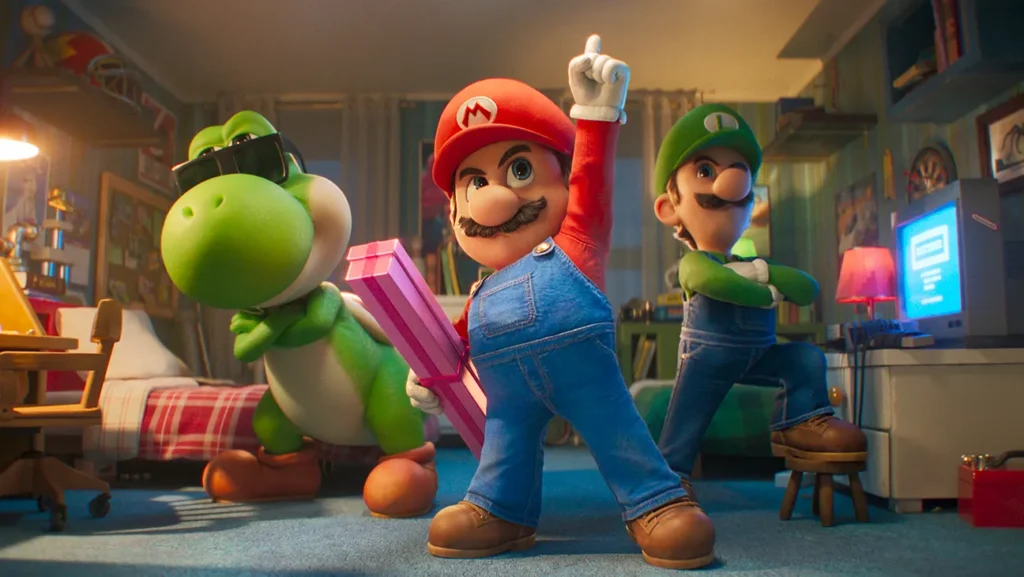
The first major test of this new strategy was The Super Mario Bros. Movie in 2023. On the surface, it looked like just another animated film. But behind the scenes, it was the culmination of Nintendo’s new Hollywood blueprint. And that blueprint really boils down to two core principles: creative control and financial skin in the game.
First, creative control. Unlike the 1993 disaster, Nintendo was deeply involved in every step of the process. Shigeru Miyamoto wasn’t just a consultant; he was a hands-on producer, working side-by-side with the animation studio, Illumination. This ensured that the film’s tone, characters, and world were all faithful to the spirit of the games. It was packed with references that spoke directly to longtime fans, but its joyful, straightforward adventure was accessible to everyone. The story was simple, but the execution felt like pure Nintendo.
Second, and this is the critical part, was the financial model. Nintendo didn’t just license Mario to Universal. They co-financed the film, splitting the $100 million production budget with Universal. By putting up their own money, Nintendo wasn’t just a creative partner; they were a business partner. That gave them leverage and a level of control that a simple licensing deal never could. It guaranteed their voice would be heard because their money was on the line.
The result? A staggering success, grossing over $1.3 billion worldwide. It proved the model worked. Nintendo could partner with Hollywood, maintain its creative integrity, and reap massive financial rewards. The blueprint was validated. The fortress walls had finally come down and not because they were breached, but because Nintendo had built a bridge on its own terms. And the success of the Mario movie paved the way for an infinitely greater challenge.
The Zelda Gamble: A Challenge Unlike Any Other
In November 2023, Nintendo made it official: a live-action film of The Legend of Zelda was in development. It would be directed by Wes Ball, known for the Maze Runner and Planet of the Apes films, and produced in partnership with Sony Pictures. But crucially, it would follow the new blueprint: Miyamoto would co-produce, and Nintendo confirmed it would co-finance more than 50% of the movie’s budget.
While this seems like a logical next step, adapting Zelda is a far more difficult and dangerous task than adapting Mario. In many ways, the very things that make the Zelda games masterpieces are what make them so hard to capture on film.
First, there’s the problem of Link. For 40 years, Link has been one of gaming’s most iconic heroes, yet he’s largely a silent protagonist. He’s a vessel for the player, an avatar for their courage and sense of discovery. Giving him a fixed voice and personality is a huge risk. If the dialogue or performance is even slightly off, it could shatter the connection millions of fans have with the character. But a silent hero in a two-hour blockbuster is almost impossible to pull off. It’s a creative catch-22 with no easy answer.
Second, Zelda’s identity is built on gameplay, not just plot. The core of the experience is exploration, puzzle-solving, and that “aha!” moment when you finally figure out a dungeon’s secret. A film is a passive, linear medium. The audience can’t “play” the world. The filmmakers have to find a way to translate that feeling of discovery into a narrative, without it feeling like you’re just watching someone else play a video game.
Finally, there’s no single, definitive version of Zelda. Over four decades, the series has presented different timelines, art styles, and tones. From the epic fantasy of Ocarina of Time to the open-world freedom of Breath of the Wild. Choosing one vision risks alienating fans of another. And the decision to make it live-action raises the stakes even higher. Animation could have easily replicated the series’ stylized look, but live-action demands a believable, tangible Hyrule. It puts immense pressure on the design, casting, and effects to feel both real and magical. A balance director Wes Ball has said he is aiming for.
This is why the Zelda movie is Nintendo’s ultimate gamble. It’s not a colorful, family-friendly adventure like Mario. It’s a mythic fantasy epic that has to satisfy one of the most passionate fanbases on earth, all while translating a gameplay-centric experience into a completely different medium.
Conclusion
Nintendo has been building toward this moment for 40 years. They waited through the embarrassment of past failures, through decades of cautiously protecting their creations, and through a complete reinvention of their own business philosophy. The live-action Legend of Zelda movie isn’t just a film; it’s the ultimate test of their new model. It’s a bet that by taking control of the creative process and the finances, they can protect the soul of their most revered franchise while finally conquering Hollywood.
The film, simply titled The Legend of Zelda, is set to release on April 30, 2027. Miyamoto has suggested the choice to have no subtitle is intentional, and the reason will become clear when we see it. This points to an original story that aims to capture the essence of the entire franchise. If they succeed, they won’t just have a blockbuster; they will have created a new paradigm for video game adaptations and solidified Nintendo’s future as a true entertainment titan. But if they fail, they risk damaging one of the most beloved legends in gaming history. It is, in every sense of the word, a 40-year gamble.
What are your biggest hopes and fears for the Zelda movie? Is live-action the right choice? Let us know on X.